


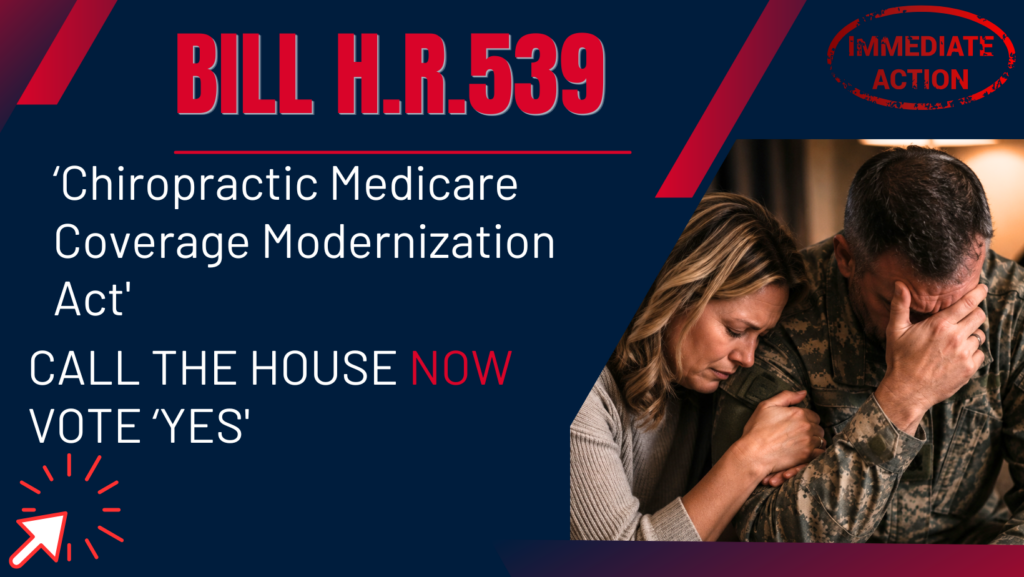
H.R.539- ‘Chiropractic Medicare Coverage Modernization Act’
Shown Here:
Introduced in House July 13, 2026
Chiropractic Medicare Coverage Modernization Act
This bill expands Medicare coverage of chiropractic services to include all services provided by chiropractors, rather than only subluxation corrections through manual manipulation of the spine.
We really need to get a all hands on deck with a Call to Action.
Call now like your life depends on it.
We need members of the House of Representatives to hear from as many of their constituents on the 14th and 15th calling in to request that the Ways and Means Committee revise HR 539 to include (1) the guardrails on reimbursements of covered services to exclude drugs, surgery and obstetrics which are outside of chiropractors training. (2) to add chiropractors to the list of providers who can privately contract (opt out) of Medicare. (3) Include a timely enactment date so that Medicare beneficiaries who have already paid into the system can reap the benefits.
Medicare does not just cover civilian seniors, it also now includes a majority of veterans who do not seek health services through the VA. Further Tricare now requires seniors to enroll in Medicare, so those who have served in the military need these changes as well.
- Call your Representative – the House switchboard number is – (202) 224-3121. If you don’t know who your Representative is, go to house.gov and in the top right hand corner you can put your zipcode in and identify your legislator. A list of State Senators is also listed with a link to access above!
- Request that your Member of Congress support and push for HR 539, the Medicare Modernization Acto to be modified with the 3 listed revisions and be marked up by Ways and Means Committee before the August Recess and get a floor vote. It is essential that the 3 revisions be added through the amendment process. (Revise HR 539 to include (1) the guardrails on reimbursements of covered services to exclude drugs, surgery and obstetrics which are outside of chiropractors training. (2) to add chiropractors to the list of providers who can privately contract (opt out) of Medicare. (3) Include a timely enactment date so that Medicare beneficiaries who have already paid into the system can reap the benefits.)
- Go to chiropractic.org and click the link on the blue banner to send a letter to your representative.
- Ask all of your friends/family to do the same.
Information below.
It has taken years to get to this point and 4 months day to day negotiations. This link leads to the announcement which confirms that MAHA, ICA and ACA are working with the chiropractic profession with concurrence that updated Medicare coverage via H.R. 539, and S. 06 in the U.S. Senate, the Chiropractic Medicare Coverage Modernization Act of 2025 needs to happen this year. The agreement requires amendments to the existing bill which put guardrails of no drugs/surgery in chiropractic (which is outside their training), remove the discrimination against Medicare beneficiaries who seek to privately contract with their chiropractor of choice if that doctor chooses to opt out of Medicare; and includes a timeline for implementation.
For the first time in 50 years, since chiropractic was first added to Medicare (1972) when a ‘but only’ limitation to the law was added at the last minute which limited the reimbursement to the adjustment only, and not the standard of care exam and when needed x-rays we have an opportunity to revise Medicare law to remove the discriminations against those who seek chiropractic care. In 1992 when the Private Contracting provision was added to Medicare, chiropractors were the only physician level providers not included. These two are directly related to the attempt to ‘contain and eliminate’ chiropractic by organized medicine – and the federal lawsuite Wilk V AMA that was went on for almost 20 years and was finalized in favor of chiropractic in 1987.
The organizations are united behind passing the bill and will strengthen it through the formal amendment process with three improvements: defining the covered benefit by each state’s authorized scope of practice, with an express exclusion of drugs, surgery, and obstetrics (which are not routine parts of chiropractic practice and for which the profession is not seeking Medicare coverage); adding Medicare private contracting rights for doctors of chiropractic modeled on the existing physician framework; and including a timely implementation schedule.
These amendments make a good bill better and keep the legislation bipartisan. The immediate goal is for a committee markup this session so the bill can pass in the 119th Congress.
MAHA and America’s Chiropractors Are Agreed: Congress Must Pass Legislation to Upgrade Medicare to Include Chiropractic Care for Seniors
The MAHA Center in Washington, D.C. is galvanizing chiropractors across America for a simple remedy to a dated Medicare system.
Jul 08, 2026
The cornerstone of the Make America Healthy Again movement is to prioritize preventive health practices in response to the nation’s chronic disease epidemic. This includes healthier diets, more exercise, and expanded access to non-drug, non-surgical care, as well as chiropractic services.

America’s senior citizens also deserve to see a chiropractor of their choosing. MAHA is moving swiftly to ensure that they can, while receiving better overall healthcare support.
This Substack is reader-supported. To receive new posts and support my work, consider becoming a free or paid subscriber.
The alignment between MAHA and the nation’s chiropractic leadership has been building all year. Each step set up the one that followed.
In March, MAHA Action President Tony Lyons presented at The Chiropractic Summit, prompting a four-hour meeting between MAHA and chiropractic leadership in Washington, D.C.

In May, the American Chiropractic Association (ACA) and International Chiropractic Association (ICA) issued a joint statement pledging collaboration to improve patient access to chiropractic care. And in June, the MAHA Chiropractic Hub launched to carry the profession’s long-standing priorities forward.
Several key initiatives are converging to ensure senior citizens get expanded chiropractic care in 2026.
The MAHA Chiropractic Hub, hosted by MAHA Center, a 501(c)(3) nonprofit, was created to host the nation’s chiropractors and connect Americans to a broader array of preventive medical services.
The nation’s two leading chiropractic associations, the ICA and the ACA, have signed a Memorandum of Understanding (MOU) with the MAHA Chiropractic Hub aligning policy priorities.

These organizations have at times disagreed, but share a commitment to modernize Medicare coverage for chiropractic services as soon as practical. As Brandon Hoffman, executive director of the MAHA Chiropractic Hub, put it: “For the first time in this fight, the entire profession is pulling in one direction. The agreement locks that alignment in, and now we turn it into committee action.”
Added Hoffman, “This happened because of the leadership of Leigh Merinoff and Deirdre Goldfarb and the enormous effort of the entire MAHA team, who turned a shared goal into a signed agreement and a working plan in a matter of months.”
The focus of the MOU is to unite chiropractors and to advocate for updated Medicare coverage via H.R. 539, and S. 06 in the U.S. Senate, the Chiropractic Medicare Coverage Modernization Act of 2025.

Dr. Joe Betz
Dr. Joe Betz, ICA President, is optimistic: “The energy behind this effort is unlike anything I have seen in my career. Chiropractors, patients, and the health freedom movement are aligned on modernizing Medicare, and the ICA will keep pressing until seniors have the same freedom to choose their chiropractor that they have with any other doctor.”

Dr. Kris Anderson
Added ACA President, Dr. Kris Anderson: “The ACA built the foundation for this moment: the bipartisan coalition, the relationships, and the case for modernization. With the entire profession now adding its weight, we have never been better positioned to get this done for our patients.”
The organizations are united behind passing the bill and will strengthen it through the formal amendment process with three improvements: defining the covered benefit by each state’s authorized scope of practice, with an express exclusion of drugs, surgery, and obstetrics (which are not routine parts of chiropractic practice and for which the profession is not seeking Medicare coverage); adding Medicare private contracting rights for doctors of chiropractic modeled on the existing physician framework; and including a timely implementation schedule.
These amendments make a good bill better and keep the legislation bipartisan. The immediate goal is for a committee markup this session so the bill can pass in the 119th Congress.

Congress added chiropractic care to Medicare coverage in 1972, but that was limited to the sole service of manipulation of the spine, commonly called an “adjustment.” Other necessary services, including initial assessment and evaluation, are still not covered some five decades later. More than one in three American seniors lives with chronic pain.
For decades, chiropractic services have demonstrably offered less intrusive, meaningful relief for patients. Senior citizens deserve the right to choose preventive chiropractic healthcare, subject to the scope of practice limitations in each state. The states regulate the scope of services chiropractors may legally provide; Medicare is the federal vehicle that provides financial support to patients for some of those services.

Supporting patients in their healthcare decision-making is a foundational goal of the MAHA movement. Millions of patients have found relief over the decades through chiropractic care that often obviates the need for prescription painkillers (risking addiction or overdose) or surgery (threatening medical complications and a long recovery). A 2020 study in the journal Pain Medicine found that patients with spinal pain who received chiropractic care had substantially lower odds of filling an opioid prescription. Prevention is generally less costly than reactive allopathic medicine: it is also often more effective.

America’s senior citizens deserve the option to utilize proven therapies already authorized by the states that address root-causes and do not rely on drugs or surgeries that often fail to relieve suffering. Especially with spinal injuries or strains, surgery should be the last medical recourse: only after milder, less intrusive treatments such as chiropractic care are employed should surgery be contemplated. Many patients will respond positively to lower-risk adjustments, saving the pain, risk, and cost of surgeries.
This is why improved chiropractic care aligns with the policy priorities of the MAHA movement. Prevention is superior to reactive cures. Less intrusive means should be employed before recourse to opioids and scalpels.

To support this initiative, MAHA invites MAHA Report readers to visit MAHA Action’s Legislative Tracker to determine whether their elected representatives support H.R. 539. If not, the website provides a precise message to send along with contact details for each congressperson. Please then follow up with a phone call to the representative’s office by July 15, repeating the petition to cosponsor and support H.R. 539.
As of July 7, 2026, 166 House members cosponsor the bill (96 Republicans and 70 Democrats), along with 15 cosponsors in the Senate.
The nation’s most prominent chiropractic organizations are in agreement that Medicare must be modernized to support improved patient outcomes, and they’re mobilizing behind H.R. 539 to do so. Chiropractors from across the nation will gather in Washington, D.C. from July 19-21 to raise awareness of H.R. 539 and garner legislative and voter support for this law change. What the bill needs now is a committee vote, this session.
America’s senior citizens have been waiting since 1972 for this simple remedy of an outdated system. With the help of the MAHA movement, 2026 can and should be the year Congress finally passes chiropractic Medicare modernization legislation and gives our seniors the care choices they deserve.
What to say when you Take a Call to Action Now:
Call Script in Support of Bill H.R. 539
“Hello, my name is [Your Name], and I am a constituent from [City, State or ZIP Code].
I’m calling today to ask Representative [Last Name] to support H.R. 539, the Chiropractic Medicare Coverage Modernization Act, and to encourage the Ways and Means Committee to move this bill forward before the August recess.
I also respectfully ask that the bill be amended to include three important revisions:
- Add clear guardrails so Medicare reimbursement excludes drugs, surgery, and obstetrics, which are outside the scope of chiropractic training.
- Allow doctors of chiropractic to privately contract (opt out) of Medicare, just as other eligible physician-level providers can.
- Include a timely implementation date so Medicare beneficiaries, including many veterans and seniors, can begin receiving these benefits without unnecessary delay.
Please let the Representative know that this legislation is important to me, and I hope they will support these amendments and work to bring H.R. 539 to a committee markup and a floor vote this session.
Thank you for taking my call.”